ISO 13849-1 vs IEC 62061: Choosing the Right Functional Safety Standard for Your Machine
- Share
- publisher
- DADISICK TECHNOLOGY LIMITED
- Issue Time
- Aug 28,2026
Summary
ISO 13849-1 (PL a-e) and IEC 62061 (SIL 1-3) are the two harmonized standards for machinery functional safety. This guide compares their rating systems, PFHd targets, risk assessment methods, architectures, strengths and typical industry use, and explains how to achieve dual compliance with one design.
Executive summary
ISO 13849-1 and IEC 62061 are the two harmonized routes to machinery functional safety. They measure the same thing — dangerous failure frequency — with different scales, and since the 2023/2021 editions they are deliberately aligned.
- ISO 13849-1:2023 (EN ISO 13849-1:2023) rates safety-related parts of control systems (SRP/CS) with Performance Levels PL a–e. It is technology-neutral: electrical, electronic, hydraulic, pneumatic and mechanical systems all qualify.
- IEC 62061:2021 (EN IEC 62061:2021, amendments A1:2024 and A2:2026) rates safety-related control systems (SCS) with SIL 1–3, the machinery-sector adaptation of the IEC 61508 approach.
- The two standards share identical PFHd targets, comparable architectures and harmonized software requirements; cross-use of components designed to one standard is explicitly permitted.
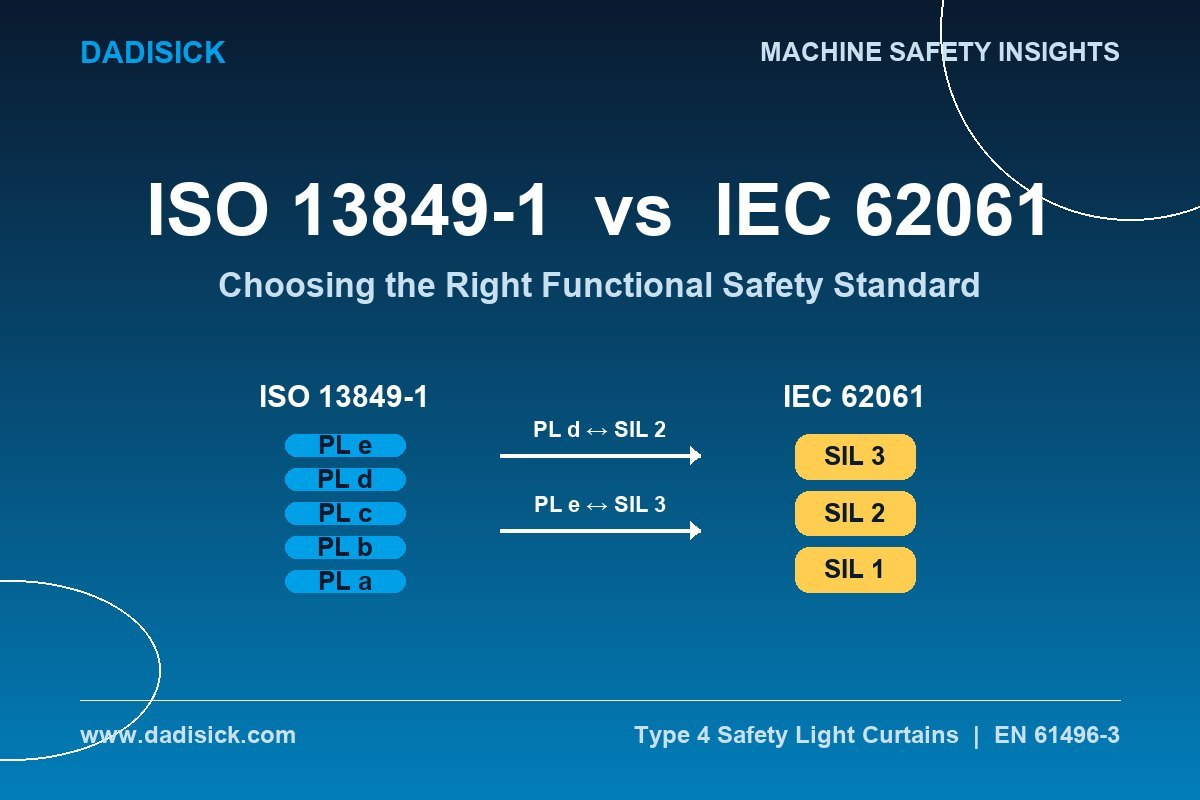
- PL ↔ SIL correspondence (informative): PL b/c ≈ SIL CL 1, PL d ≈ SIL CL 2, PL e ≈ SIL CL 3. PL a has no SIL equivalent.
- Bottom line: if a Type-C product standard or customer specification names one route, use it. Otherwise choose ISO 13849-1 for electro-mechanical / pneumatic / hydraulic safety circuits and IEC 62061 for programmable electronic systems with complex software. A single design can usually be documented under both.
Image placeholder
Hero illustration: two safety-standard routes — electro-mechanical (gears, relays) and programmable electronic (chips, code) — converging on a protected machine
1. What each standard is
| ISO 13849-1:2023 | IEC 62061:2021 | |
|---|---|---|
| Full title | Safety of machinery — Safety-related parts of control systems — Part 1: General principles for design | Safety of machinery — Functional safety of safety-related control systems |
| Issuing body | ISO (TC 199) / CEN (TC 114) | IEC (TC 44) / CENELEC |
| Rating scale | Performance Level PL a → e | Safety Integrity Level SIL 1 → 3 (SIL 4 is not used for machinery) |
| Scope | Safety-related parts of control systems (SRP/CS) in any technology | Safety-related control systems (SCS) in any technology (since 2021; previously electrical only) |
| Operating modes | High demand / continuous mode only | High demand / continuous mode only |
| Low-demand applications | Out of scope — use IEC 61508 series | Out of scope — use IEC 61508 series |
| Companion standard | ISO 13849-2 (validation); ISO 13849-1:2023 Annex N software | Based on IEC 61508; verification and validation built into the standard |
| EU harmonization | EN ISO 13849-1:2023 cited in the OJEU (May 2024), transition until 15 May 2027 | EN IEC 62061:2021 cited in the OJEU (April 2022, CID 2022/621) |
2. The two rating systems: PL and SIL
Both standards ultimately quantify the same thing: the average frequency of a dangerous failure per hour (PFHd) that the safety function may exhibit. The PFHd target ranges are identical in both documents.
Image placeholder
Infographic: five ascending PL steps (a–e) beside three SIL blocks (1–3), sharing the same PFHd scale
2.1 PL ↔ SIL ↔ PFHd correspondence table
| Performance Level (ISO 13849-1) | PFHd range (1/h) | Equivalent SIL (IEC 62061 / IEC 61508) |
|---|---|---|
| a | ≥ 10⁻⁵ to < 10⁻⁴ | No SIL equivalent |
| b | ≥ 3×10⁻⁶ to < 10⁻⁵ | SIL CL 1 (upper portion) |
| c | ≥ 10⁻⁶ to < 3×10⁻⁶ | SIL CL 1 |
| d | ≥ 10⁻⁷ to < 10⁻⁶ | SIL CL 2 |
| e | ≥ 10⁻⁸ to < 10⁻⁷ | SIL CL 3 |
2.2 How each standard achieves the target
| Design element | ISO 13849-1:2023 | IEC 62061:2021 |
|---|---|---|
| Structural building block | Categories B, 1, 2, 3, 4 (behavioural architecture classes) | Subsystem architectures: basic / single channel with diagnostics / double channel |
| Quantitative inputs | Channel MTTFd (low 3–10 y / medium 10–30 y / high 30–100 y), Diagnostic Coverage DC (none <60% / low 60–90% / medium 90–99% / high ≥99%), CCF scoring (≥ 65/100 points) | PFHd per subsystem, DC-based architectural constraints, CCF measures |
| Output label | Achieved performance level PL | Achieved SIL (the 2021 edition renamed SIL claim limit to maximum SIL of a subsystem) |
| Software requirements | Clause 7 (use cases: software safety requirements, parameterization, verification) | Clause 8 (use cases, independence of software verification) |
| Validation | ISO 13849-2-based validation (adopted as Clause 10 of the 2023 edition) | Validation within the standard; degrees of independence defined |
| Typical tooling | SISTEMA (IFA, free), PAScal, SafetyEvaluator | PAScal, SIL verification spreadsheets, supplier PFHd data |
Category ⇄ architecture correspondence (informative): Category B → Basic · Category 1 → Basic (well-tried components and principles) · Category 2 → Single channel with diagnostics · Category 3 → Double channel (redundant channels, fault detection, DC low–medium) · Category 4 → Double channel (high DC, accumulation of faults considered).
3. Risk assessment: how the required level is determined
Both standards start from a risk assessment according to EN ISO 12100 (risk analysis → risk evaluation → risk reduction). The difference is the parameter set used to derive the required level.
Image placeholder
Scene illustration: a safety engineer with a tablet performing a documented risk assessment in front of a robotic-arm hazard zone
| Step | ISO 13849-1 | IEC 62061:2021 |
|---|---|---|
| Starting point | Risk assessment per EN ISO 12100 | Risk assessment per EN ISO 12100 |
| Parameters | Risk graph: S severity (S1 slight / S2 serious), F frequency and duration of exposure (F1 seldom / F2 frequent), P possibility of avoiding (P1 possible / P2 hardly possible) | Se severity of harm (1–4), Fr frequency and duration of exposure (1–5), Pr probability of the hazardous event (1–5), Av possibility of avoiding or limiting harm (1–5) |
| Output | Required performance level PLr (a–e) | Required SIL (1–3) via the assignment table |
| Style | Qualitative graph → quantitative verification | Semi-quantitative parameter classification + quantitative verification |
| Documentation emphasis | Safety requirements specification; risk graph result | Safety Requirements Specification (SRS) is mandatory (explicit clause) |
4. Strengths and limitations
| Aspect | ISO 13849-1 | IEC 62061 |
|---|---|---|
| Technology coverage | Excellent — genuinely covers pneumatic, hydraulic, mechanical and electrical | Good — all technologies since 2021, but the heritage and data ecosystem remain electrical/electronic |
| Learning curve | Shorter; PL logic and SISTEMA are widely taught | Steeper; SIL/SRS concepts assume IEC 61508 familiarity |
| Simple electro-mechanical circuits (safety relays, contactors) | Natural fit | Possible, but heavier than needed |
| Complex programmable systems (safety PLCs, drives, networks) | Possible (Cat 2/3/4 + software clauses) | Natural fit — designed for it |
| Cross-industry recognition | Very high (Europe, machine tools, packaging, robotics) | Very high where IEC 61508 culture exists (drives, process, semiconductor) |
| Ecosystem | Component MTTFd/DC data ubiquitous; SISTEMA free tool | Supplier PFHd data for subsystems; PAScal and similar |
| Software depth | Use-case based (2023) | Use-case based, independence of verification required (2021) |
| Weakness | Software/systematic-integrity requirements less explicit than IEC 61508-style thinking | Historically over-engineered for simple circuits; documentation burden heavier |
5. Typical applications and industry preferences
| Application / industry | Common route | Why |
|---|---|---|
| Safety relays, contactor-based circuits, presses, guillotines | ISO 13849-1 | Electro-mechanical SRP/CS; Cat 1–4 concept fits perfectly |
| Packaging machinery, food and beverage lines | ISO 13849-1 (often specified by Type-C standards) | Simple-to-medium safety functions, PL c/d typical |
| Machine tools, machining centres | ISO 13849-1 (e.g. PL d / Cat 3 per many Type-C standards) | Prescriptive in C-type standards |
| Industrial robots and AGVs | ISO 13849-1 (PL d / Cat 3 referenced by ISO 10218-1:2011, ISO 3691-4) | Established precedent; new editions increasingly accept either route |
| Safety drives / adjustable speed drives (STO, SLS, SS1) | IEC 62061 / IEC 61508 family | IEC 61800-5-2 publishes SIL-rated safety functions |
| Programmable safety controllers, safety networks (PROFIsafe, CIP Safety, FSoE) | IEC 62061 | SIL/PFHd data published per subsystem; software depth required |
| Safety light curtains / ESPE (EN/IEC 61496) | Both — datasheets claim Type 4 → PL e, Cat. 4, SIL 3 | Dual-rated product claims are the norm (see section 7) |
| Semiconductor, pharmaceutical equipment | IEC 62061 | Engineering culture and customer specs |
6. Decision guidance and dual-compliance strategy
Image placeholder
Illustration: an engineer choosing between a gear-marked route and a chip-marked route, both leading to the same factory
Which standard should you use?
Choose ISO 13849-1 when
- Your safety functions are implemented with relays, contactors, pneumatic/hydraulic valves or simple electronics.
- A Type-C standard or customer specification references PL / Category.
- Your team is new to functional safety — the PL route is the gentler entry point.
- You want free tooling (SISTEMA) and abundant component MTTFd/DC data.
Choose IEC 62061 when
- The safety function is executed by programmable electronic systems (safety PLCs, drives, networks) with substantial software.
- Your supply chain publishes SIL/PFHd data (drives, safety controllers).
- Customers or integrators demand an IEC 61508-heritage approach, SRS documentation and verification independence.
- You operate in sectors where SIL language is the norm.
Both standards, one design (dual compliance) — recommended practice
- One risk assessment, two targets. Perform one risk assessment per EN ISO 12100; derive both PLr and SIL (the informative correspondence table makes this easy).
- Write the SRS once. Both standards now effectively require a Safety Requirements Specification.
- Choose dual-rated subsystems. Select components whose published data covers both worlds (most safety components are dual-rated).
- Verify the PFHd budget once. It is the common currency of both standards.
- Claim dual ratings. Use PL e, Category 4, SIL CL 3 style claims in datasheets and Declarations of Conformity — this is exactly how leading safety sensor suppliers present Type 4 products.
- Validate once, file once. Validate per ISO 13849-2 requirements (now embedded in ISO 13849-1:2023 Clause 10) and the validation provisions of IEC 62061; keep one technical file for both.
7. What this means for safety light curtains (ESPE)
Electro-sensitive protective equipment (light curtains, light grids, area scanners) is designed to EN/IEC 61496 (Part 1 general, Part 2 AOPD, Part 3 AOPDDR) and rated for functional safety as follows:
Image placeholder
Product scene: a Type 4 safety light curtain forming a protective beam grid in front of a press machine hazard zone
| ESPE type (EN/IEC 61496) | Usable in applications up to |
|---|---|
| Type 2 | PL c (ISO 13849-1) / SIL 1 (IEC 62061) |
| Type 3 (introduced in the 2020 4th edition) | PL d / SIL 2 |
| Type 4 | PL e (Category 4) / SIL 3 |
Two practical takeaways for buyers
- Type 4 is the top ESPE class. It corresponds to the highest PL/SIL ratings a machine can claim, suitable for hazards with serious injury potential (PL e / SIL 3).
- Type examination matters. Because EN/IEC 61496 is not a harmonized standard under the EU Machinery Directive/Regulation, there is no automatic presumption of conformity — independent type examination by a recognized body (e.g. TÜV, DEKRA, SGS) is established market practice. A DADISICK Type 4 safety sensor carries type-examination and dual PL e / SIL 3 claims so integrators can rely on the numbers without re-deriving them.
8. Version and harmonization status — keep this table current
| Standard | Edition | EN version | OJEU harmonization (Machinery Directive) | Notes |
|---|---|---|---|---|
| ISO 13849-1 | 4th ed., 2023-04 | EN ISO 13849-1:2023 (2023-11) | Cited May 2024; replaces EN ISO 13849-1:2015; transition until 15 May 2027 | 2023 edition restructured; new software, EMI-immunity and SRS annexes |
| ISO 13849-2 | Validation | Revision in progress (EN ISO 13849-2:20xx) | — | Expect a new edition aligned with ISO 13849-1:2023 |
| IEC 62061 | 2nd ed., 2021-03 | EN IEC 62061:2021 (2022-01) | Cited April 2022 (CID 2022/621); EN 62061:2005 presumption ended 11 Oct 2023 | Amendments: IEC 62061:2021/AMD1:2024 (EN A1:2024), AMD2:2026 (EN A2:2026) |
| EN ISO 12100 | 2010 | EN ISO 12100:2010 | Cited | Risk assessment and risk reduction (Type-A standard) |
Regulatory timeline to watch (EU)
- Until 19 January 2027: Machinery Directive 2006/42/EC applies; Declaration of Conformity may reference both Directive and Regulation if compliant.
- From 20 January 2027: Machinery Regulation (EU) 2023/1230 applies exclusively (no transition period). Harmonized standards for the Regulation are expected to carry over with minor adjustments — apply EN ISO 13849-1:2023 and EN IEC 62061:2021 now to be future-proof.
- What the Regulation adds: software/cyber-security requirements for safety functions, stricter conformity assessment for higher-risk machinery, new economic-operator duties (importers/distributors), and digital technical documentation.
9. References and sources
- ISO 13849-1:2023, Safety of machinery — Safety-related parts of control systems — Part 1: General principles for design (ISO; 4th edition, 2023)
- ISO 13849-2:2012, Safety of machinery — Safety-related parts of control systems — Part 2: Validation (ISO)
- IEC 62061:2021 + AMD1:2024 + AMD2:2026, Safety of machinery — Functional safety of safety-related control systems (IEC; 2nd edition, 2021)
- IEC 61508 (all parts), Functional safety of electrical/electronic/programmable electronic safety-related systems (IEC)
- EN ISO 12100:2010, Safety of machinery — General principles for design — Risk assessment and risk reduction
- EN/IEC 61496 series (Parts 1, 2, 3), Safety of machinery — Electro-sensitive protective equipment (IEC 61496-1:2020, 4th ed.)
- Regulation (EU) 2023/1230 on machinery, OJ L 165, 29 June 2023 (EUR-Lex) — applicable 20 January 2027
- European Commission, Machinery sector page and harmonized standards database (single-market-economy.ec.europa.eu)
- ISO Online Browsing Platform (iso.org/obp) — edition and status verification
- Pilz, EN/IEC 61496 and IEC 62061 technical reference pages (pilz.com) — PFHd/SIL tables and harmonization status
- DGUV Test, EU Machinery Regulation conformity-assessment guidance (dguv.de)
Document control: verify standard editions and OJEU citation status at least annually or before publishing updates. Last verified: 2026-08.