Inductive Proximity Sensor Selection Guide: Shielded vs Unshielded, Sensing Distance and Housing Types
- Share
- publisher
- DADISICK
- Issue Time
- Oct 28,2026
Summary
Shielded or unshielded? M12 or M30? This guide explains how an inductive proximity sensor really works, how nominal sensing distance shrinks on aluminium and stainless steel, which housing and output to specify, and the installation mistakes that cause false triggers - with an eight-point selection checklist for machine builders.

Inductive proximity sensors are the most widely installed sensor in industrial automation, and they are also the component most often replaced without investigation. The sensor is rarely at fault. The gap is almost always between the nominal sensing distance printed in the datasheet and the distance the real application can actually achieve.
This guide works through the four decisions that determine whether an inductive sensor runs reliably for a decade or fails in a month: shielding, sensing distance, housing and environment. The definitions follow IEC 60947-5-2, so the numbers can be applied directly to a machine design.
What this guide answers
- Why the same M12 sensor reaches 4 mm in air and only 1.8 mm on aluminium
- When a shielded sensor is mandatory, and when it silently costs you range
- How much metal-free space an unshielded sensor really needs
- Which housing, output and protection variant fits a given machine
How an inductive proximity sensor works
An inductive sensor contains an LC oscillator that drives a coil behind the sensing face. The coil radiates an alternating electromagnetic field. When a metal target enters that field, eddy currents form on the target surface, and the energy they absorb damps the oscillation.
A Schmitt trigger monitors the oscillation amplitude. When the amplitude drops past a threshold, the output changes state. Because the effect depends on the conductivity and permeability of the target, the same sensor behaves very differently on mild steel, stainless steel and aluminium. That single fact explains most field complaints about inductive sensors.
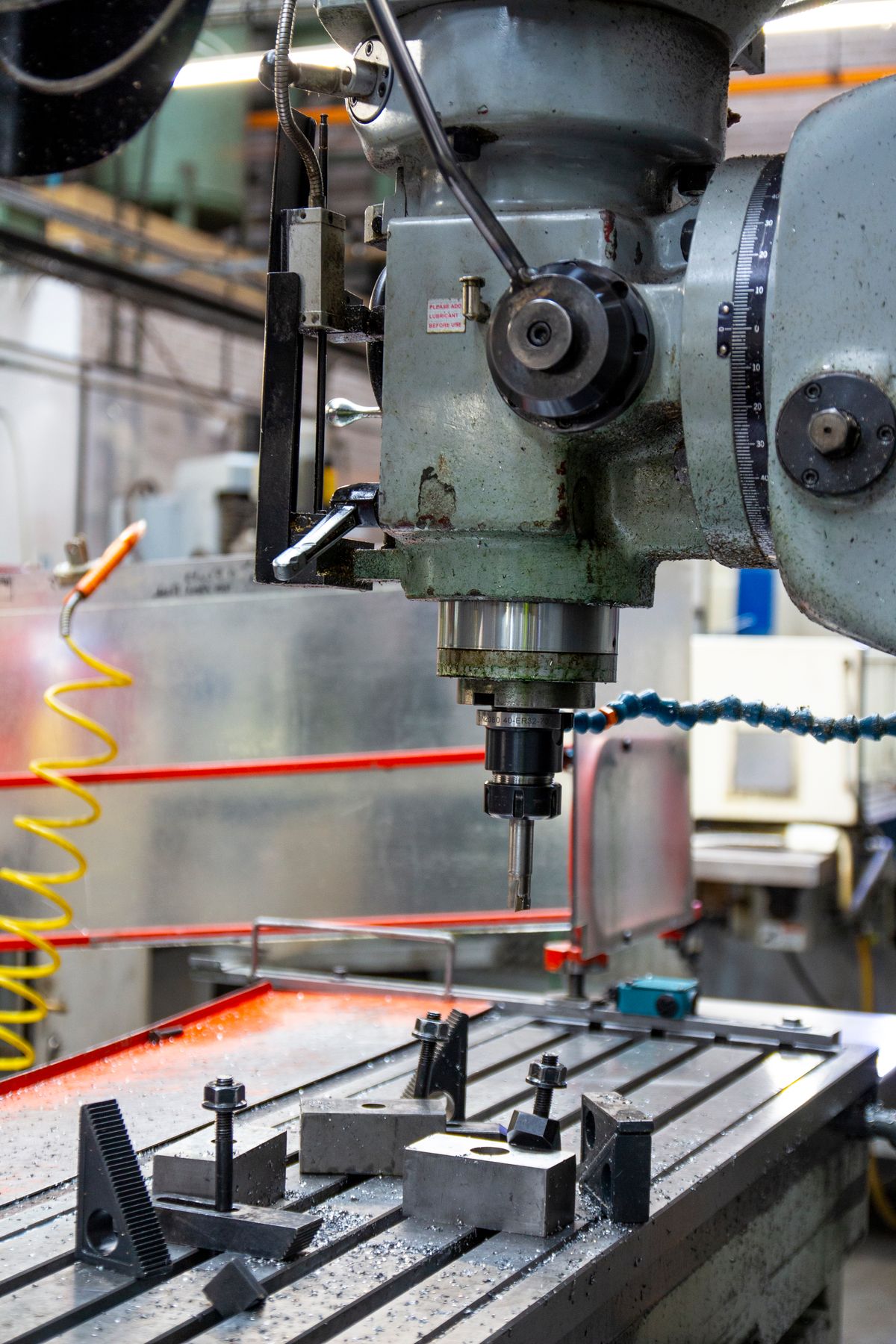
Fixture, spindle and tooling are all metal, which is exactly what an inductive sensor has to distinguish from the workpiece itself.
Shielded or unshielded: the decision that limits everything else
A shielded sensor wraps its coil in a metal cup that concentrates the field forward. An unshielded sensor has no cup, so the field spreads sideways as well as forward. The trade is simple: shielding buys installation freedom and costs sensing distance.
| Aspect | Shielded (flush mountable) | Unshielded (non-flush) |
|---|---|---|
| Sensing distance | Shorter for the same housing | Roughly 1.5 to 2 times longer |
| Mounting | Can sit flush in a metal bracket | Needs a metal-free zone around the face |
| Field shape | Concentrated in front of the face | Wider, spreads sideways |
| Best for | Tight fixtures, thin brackets, crowded tooling | Longer reach, dirty or vibrating targets |
If a mounting plate is already designed with a through-hole and no clearance around it, a shielded sensor is usually the only option that will not produce false triggers from the bracket itself.
Nominal, assured and real sensing distance
Nominal sensing distance (Sn) is measured with a standard target: a square mild steel plate 1 mm thick, with a side length equal to the diameter of the sensing face or three times Sn, whichever is larger. Assured operating distance (Sa) is what remains guaranteed across temperature and manufacturing tolerance, conventionally 0.81 times Sn.
The real distance in your machine is smaller again, because the target is rarely mild steel. Multiply Sn by the correction factor of the target material.
| Target material | Typical correction factor | Sn 4 mm becomes |
|---|---|---|
| Mild steel (St37) | 1.00 | 4.0 mm |
| Stainless steel 304 | 0.85 | 3.4 mm |
| Brass | 0.50 | 2.0 mm |
| Aluminium | 0.45 | 1.8 mm |
| Copper | 0.40 | 1.6 mm |
Design rule
Size the mechanical stop so the target sits at 60 to 80 percent of the corrected sensing distance. Using the full nominal distance leaves no margin for temperature drift, target wear or mounting tolerance.

Linear rails and stops are usually where the sensor gap is set, and where mounting tolerance quietly eats the margin.
Housing size and what it tells you
The barrel diameter is not cosmetic. It sets the coil size, and therefore both the sensing distance and the hardware around it.
M8
1 to 2 mm sensing range. Used for small fixtures, semiconductor tooling and end-of-stroke confirmation where space is the constraint.
M12
2 to 4 mm shielded, up to 8 mm unshielded. The default for general machine building and the most common size on European machinery.
M18
5 to 8 mm. Chosen when the target cannot be brought close, for example on a conveyor roller or a swinging guard.
M30
10 to 15 mm. Used for coarse position sensing on heavy equipment where mechanical play is significant.
Rectangular
Flat housings fit into profiles and gripper jaws where a barrel cannot be mounted. See the square inductive proximity sensor range.
Ring
Detects any metal passing through the bore, used for wire break detection, screw counting and small-part feed monitoring. Browse the ring sensor range.
When the environment dictates the model
Standard IP67 sensors fail for reasons that have nothing to do with electronics: weld spatter, cutting fluid, hydraulic pressure, heat soak. DADISICK builds dedicated variants for each case, and selecting the wrong one is the most expensive mistake in this category.
- Anti-welding slag and high magnetic resistance for spot welding cells, where spatter and the welding magnetic field destroy standard sensors.
- High and low temperature resistant models for ovens, moulds and cold storage, where a standard sensor drifts out of range.
- Corrosion resistant versions for chemical, plating and food washdown areas.
- High pressure resistant sensors rated for hydraulic cylinder end-position feedback.
- Explosion-proof designs for hazardous areas where a spark is not an acceptable failure mode.
- Metal face variants that survive repeated mechanical impact from the target.
An eight-point selection checklist
Run these in order. Each one narrows the catalogue faster than browsing by model number.
- Confirm the target is metal. Inductive sensors do not see plastic, wood, glass or liquid.
- Identify the target material, then apply the correction factor before choosing a distance.
- Decide whether the mounting allows a metal-free zone. If not, specify shielded.
- Pick the housing from the available space, not from the longest sensing distance.
- Choose PNP or NPN to match the PLC input card, and NO or NC to match the fail-safe logic.
- Check the switching frequency against the actual cycle rate, with margin for bounce.
- Match the protection class to the coolant, washdown or cleaning regime.
- Verify ambient temperature, including radiant heat from the process, not just shop air.
Installation errors that shorten sensor life
Six faults that come back as warranty claims
- An unshielded sensor pressed into a metal pocket. The bracket becomes part of the field and the sensor stays permanently on.
- Two identical sensors mounted face to face closer than the minimum spacing, so they interfere and chatter.
- Parallel mounting of same-frequency sensors below the manufacturer gap, causing random dropouts.
- Cable routed along a moving drag chain without strain relief, breaking the conductor inside the insulation.
- Sensor body used as a mechanical stop, cracking the potting and letting coolant in.
- Target smaller than the standard target, which reduces sensing distance without any visible warning.
Frequently asked questions
Can an inductive sensor detect plastic or glass?
No. Inductive sensors respond only to conductive metal targets. For plastic, glass, wood or liquid, a photoelectric sensor or a capacitive sensor is the correct choice, and the two technologies should not be substituted for each other during a shortage.
Is an inductive proximity sensor a safety device?
No. A standard inductive sensor is a presence detector with no internal redundancy and no self-monitoring, so it cannot be used to protect people. Machine guarding requires devices designed and certified for that purpose, such as safety light curtains rated to Type 4 and PL e, safety interlock switches or safety mats.
Why does my sensor work on steel but miss aluminium parts?
Because aluminium has a much lower correction factor, typically around 0.45. A sensor rated at 4 mm on mild steel reaches only about 1.8 mm on aluminium. Either reduce the gap or specify a sensor with a longer nominal range.
What is the difference between Sn, Sa and Sr?
Sn is the nominal distance on the standard target, Sa is the assured operating distance at 0.81 times Sn, and Sr is the real switching distance measured against the actual target material in the actual installation.
Putting the selection together
A reliable inductive sensor installation is not the one with the longest range. It is the one where the corrected sensing distance, the mounting clearance and the environmental rating all leave margin. Start from the target material, work backwards through the correction factor, and choose the housing last.

Most sensor replacements happen at the setup stage, when the gap is set by eye rather than by calculation.
DADISICK supplies the full range from ultra-miniature and standard models through to analog output and limit switch style housings, with the special-environment variants listed above. If the application does not fit a catalogue row, send the drawing and the target material and we will confirm the corrected sensing distance in writing.