Photoelectric Switch vs Proximity Switch: Which Is Right for Your Application?
- Share
- publisher
- DADISICK Technical Team
- Issue Time
- Aug 19,2026
Summary
Compare photoelectric switches and proximity switches across detection principle, target material, sensing distance, and environment, then choose the right DADISICK sensor for your automation system.
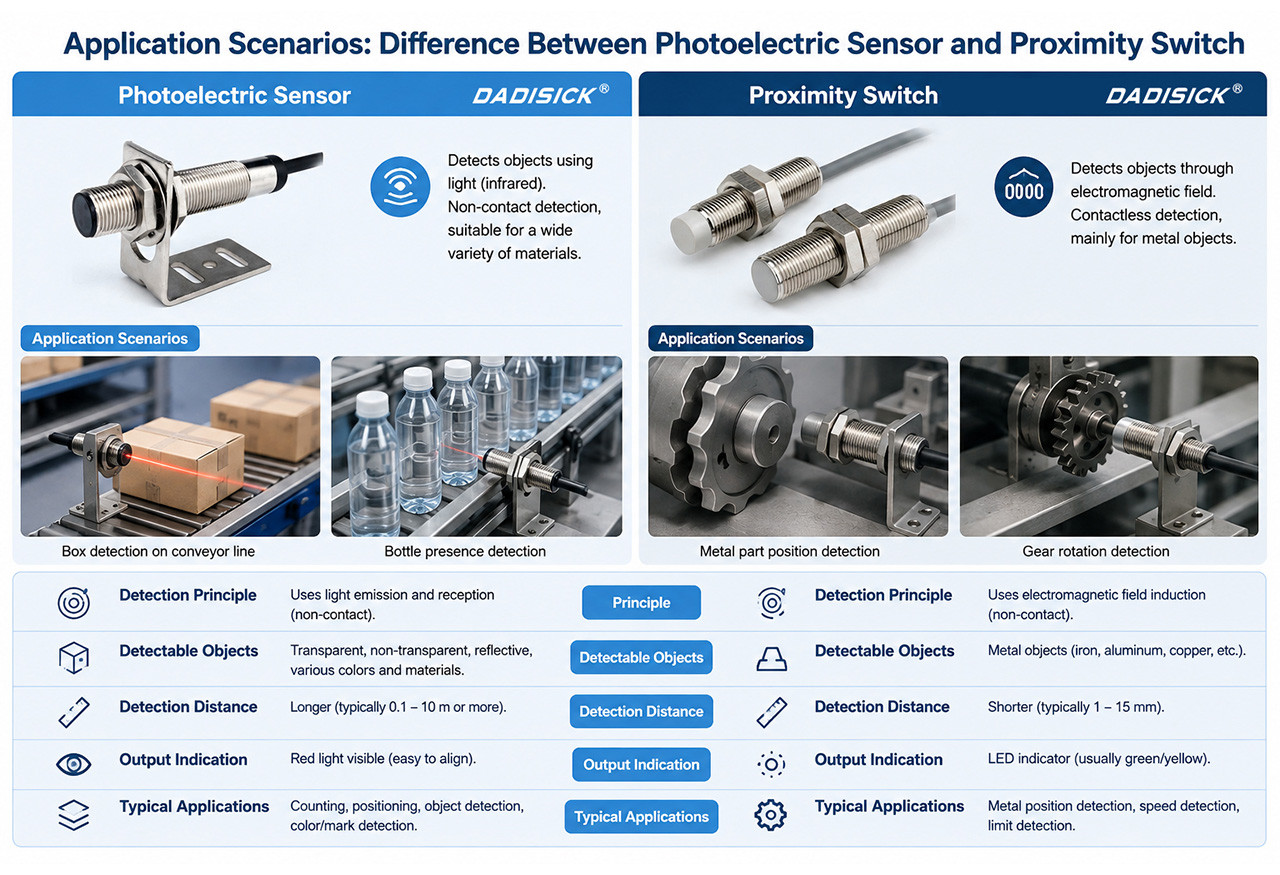
A photoelectric switch and a proximity switch can both detect the presence, position, or passage of an object without anyone physically touching the target. Yet they work on completely different principles: one uses a beam of light, the other an electromagnetic field. Pick the wrong one and you risk missed detections, false triggers, premature failure, or a sensor that simply cannot "see" your product on the line. This guide breaks down how each works, where it wins, where it struggles, and how to match the right DADISICK sensor to your application.
What Is a Photoelectric Switch?
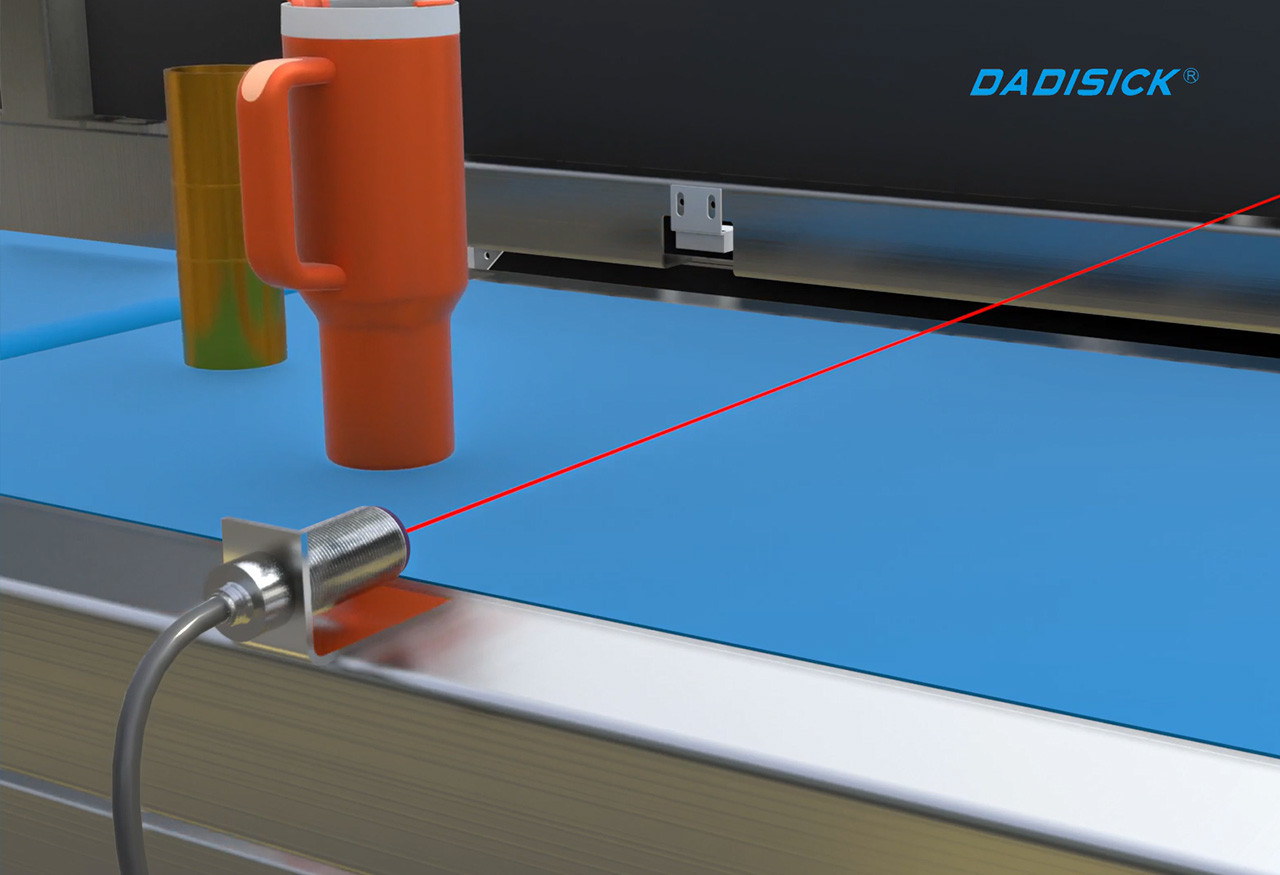
A photoelectric switch (photoelectric sensor) is an electronic device that detects an object by sensing a change in a light beam. It emits light — typically a visible red LED or infrared/laser — and registers the target through one of three modes:
- Through-beam: the emitter and receiver sit opposite each other; the target breaks the beam.
- Retro-reflective (specular): the beam reflects off a reflector back to the receiver; the target blocks it.
- Diffuse reflective: the sensor both emits and receives; the target reflects the light back to the receiver.
Because detection depends on light rather than contact, a photoelectric switch can sense almost any material — metal, plastic, wood, cardboard, glass, or transparent film — as long as it interacts with the beam. DADISICK's DK-GF43 Universal Square Photoelectric Sensor covers all three modes in one family: diffuse reflection up to 150 mm, specular up to 2 m, and through-beam up to 10 m, operating on DC 12–24 V with an IP65 PC housing rated for −25 to +55 °C.
What Is a Proximity Switch?
A proximity switch (proximity sensor) detects an object without contact by generating a sensing field. The most common industrial type is the inductive proximity switch, which creates an electromagnetic field and reacts when a conductive (usually metal) target enters it. A capacitive proximity switch extends detection to most materials including non-metals, while ultrasonic proximity switches use sound waves.
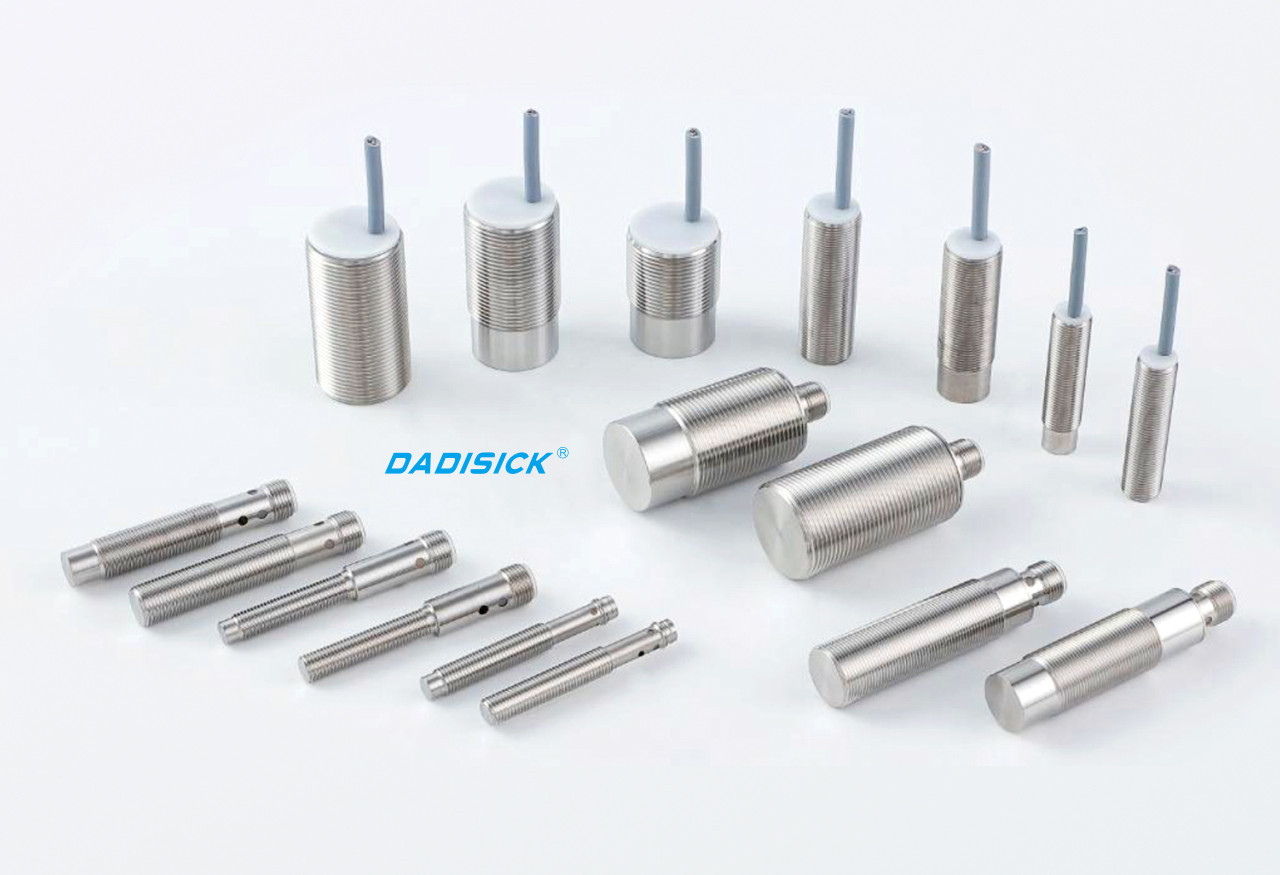
Inductive proximity switches are prized for ruggedness in metal-handling automation. DADISICK's Standard Inductive Proximity Sensor ships in M8, M12, M18, and M30 threaded housings with a 2–8 mm sensing range, DC 10–30 V 3-wire operation, and selectable NPN/PNP, NO/NC outputs in a stainless-steel body. For hazardous areas, the Explosion-proof Inductive Proximity Sensor offers sizes from M4 to M30, 0.8–30 mm range, 6–12 VDC NAMUR operation, and CE/ROHS compliance for chemical, oil, and gas environments.
Photoelectric Switch vs Proximity Switch: The Core Difference
Detection Principle: Light Beam vs Electromagnetic Field
The fundamental split is what does the detecting. A photoelectric switch reads a light beam, so it "sees" the physical presence of an object regardless of what the object is made of. A proximity switch reads a field, so an inductive model responds to the conductivity of metal rather than the object's shape. If your line moves mixed materials, photoelectric detection is usually safer; if you only ever handle metal, an inductive proximity switch is simpler and cheaper.
Target Material: Any Material vs Metal (Mostly)
A photoelectric switch detects nearly anything with usable reflectivity — even transparent bottles or colored cartons. An inductive proximity switch detects metal only; plastic, wood, or liquid will not trigger it. A capacitive proximity switch broadens this to non-metals, but trades some precision. When the target material varies, default to photoelectric.
Sensing Distance: Meters vs Millimeters
This is where the two diverge sharply. Photoelectric switches reach far — DADISICK through-beam models detect up to 10 m. Inductive proximity switches operate in the millimeter range (typically 2–30 mm). If you must detect from a distance or across a wide conveyor, photoelectric wins; if detection happens right at a machine face, proximity is plenty.
Environmental Sensitivity: Dust/Light vs Metal Interference
A photoelectric switch can be fooled by dust, oil film, heavy fog, strong ambient light, or a target that is too dark or too reflective. A proximity switch is immune to those optical problems but can be affected by nearby metal or improper shielding. In a dirty, oily, or brightly lit plant, an inductive proximity switch often proves the more stable choice.
| Factor | Photoelectric Switch | Proximity Switch (Inductive) |
|---|---|---|
| Detection principle | Light beam (LED/laser) | Electromagnetic field |
| Target material | Any (metal, plastic, glass, film) | Metal only |
| Sensing distance | Centimeters to meters (through-beam up to 10 m) | Millimeters (2–30 mm typical) |
| Environment | Clean, controlled lighting | Dusty, oily, bright, or hazardous |
| Output | NPN/PNP 3-wire, PLC-ready | NPN/PNP 3-wire / NAMUR |
Advantages of a Photoelectric Switch
- Long detection range. Through-beam models reach several meters, ideal for wide conveyors, large packages, and overhead gates.
- Material-agnostic detection. Metal, plastic, glass, cardboard, or transparent film — if light interacts with it, the sensor sees it.
- Precise object profiling. Diffuse and specular modes enable counting, sizing, and position checks without contact, supporting high-speed lines.
- Non-contact, zero wear. Like all electronic sensors, there is no mechanical part to wear out from repeated triggering.
Advantages of a Proximity Switch
- Extreme ruggedness. With no lens to cloud and no beam to break, an inductive proximity switch shrugs off dust, oil, vibration, and ambient light.
- Simple, reliable metal detection. For metal parts, fixtures, or machinery, it gives a clean, repeatable signal with minimal setup.
- Compact and cost-effective. Small threaded barrels (M8–M30) mount easily and cost less than long-range photoelectric systems for close-range metal work.
- Hazardous-area options. Explosion-proof inductive models bring non-contact detection into chemical, oil, and gas environments safely.
Where Each One Falls Short
Photoelectric switch limitations: optical surfaces need occasional cleaning; very transparent, mirror-like, or low-contrast targets can be tricky; direct sunlight or welding flash may require filtering.
Proximity switch limitations: inductive models detect metal only and only at short range; nearby metal or incorrect shielding can cause false triggers; capacitive models can be sensitive to moisture and dust.
When to Choose a Photoelectric Switch
- You must detect non-metallic or mixed-material objects (cartons, bottles, plastic parts, food packaging).
- Detection happens at medium to long range (over a few centimeters, up to meters).
- You need to count, size, or position items on a fast line where contact is impossible.
- The environment is relatively clean and controlled (indoor, low dust, manageable lighting).
When to Choose a Proximity Switch
- Your target is metal and sits close to the sensor face (2–30 mm typical).
- The environment is harsh — dusty, oily, wet, or brightly lit — where a lens would fail.
- You want minimal maintenance and a "fit-and-forget" metal-presence signal.
- The application is in a hazardous or explosive area needing certified explosion-proof hardware.
Key Factors to Consider Before Choosing
| Factor | Choose Photoelectric When… | Choose Proximity When… |
|---|---|---|
| Target material | Mixed or non-metal (plastic, glass, cardboard) | Metal only, at close range |
| Sensing distance | Centimeters to meters (through-beam up to 10 m) | Millimeters (2–30 mm typical) |
| Environment | Clean, controlled lighting | Dusty, oily, wet, bright, or explosive |
| Output / signal | NPN/PNP 3-wire, PLC-ready | NPN/PNP 3-wire, NAMUR for hazardous zones |
| Maintenance | Lens cleaning acceptable | Near-zero maintenance preferred |
Frequently Asked Questions
Can a proximity switch detect non-metal objects?
An inductive proximity switch detects metal only. For non-metals, use a capacitive proximity switch or a photoelectric switch. DADISICK also offers ultrasonic proximity sensors that detect most materials via sound waves.
Which sensor should I use for long-distance detection?
A photoelectric switch. Through-beam photoelectric models from DADISICK detect up to 10 m, far beyond the millimeter range of inductive proximity switches.
Are photoelectric switches affected by object color or ambient light?
Yes — very dark, transparent, or mirror-like targets and strong ambient light can affect performance. In those cases, choose the right mode (through-beam is most robust) or switch to an inductive proximity switch if the target is metal.
How do I choose between NPN and PNP output?
Match your PLC or controller's input type. NPN (sinking) and PNP (sourcing) are both common; DADISICK photoelectric and inductive sensors offer both, so confirm your system's wiring standard before ordering.
Final Thoughts
A photoelectric switch is the better pick when you need long-range, material-agnostic, non-contact detection on clean, fast lines. A proximity switch — especially the inductive type — wins for close-range metal detection in dirty, bright, or hazardous environments where ruggedness matters more than reach. The right answer depends on your target material, sensing distance, operating conditions, and wiring standard.
Not sure which DADISICK sensor fits your system? Our engineers help you select, wire, and integrate the exact model — from the DK-GF43 photoelectric family to standard and explosion-proof inductive proximity switches — with most products in stock for fast shipment. Contact the DADISICK technical team for a selection recommendation, or send an inquiry to request a quote today. Explore more application guides in our blog.