What Is a Measuring Light Curtain?
- Share
- Issue Time
- Mar 23,2026
Summary
Learn what a safety light curtain is, how it works, key technical specifications, where it is used in industrial safety, applicable international standards, common misconceptions, and practical FAQs for machine safeguarding.
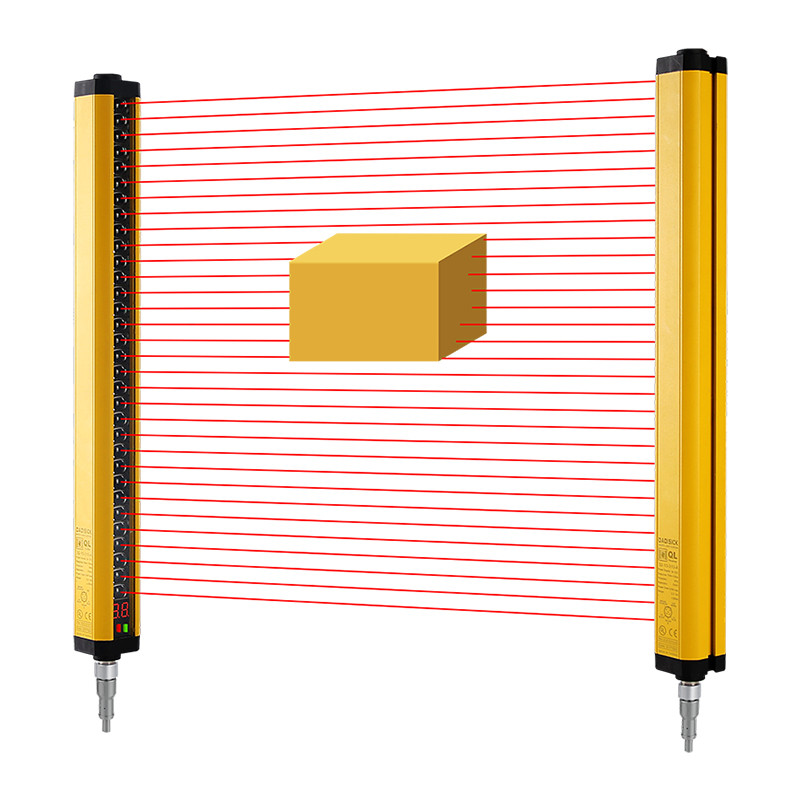
A measuring light curtain is an optical sensing device used for non-contact detection and dimensional measurement of objects passing through a defined detection area. It consists of a transmitter and receiver array that forms a dense grid of infrared beams to capture object size, position, and profile.
Unlike safety light curtains, measuring light curtains are designed for measurement and detection tasks rather than personnel protection.
Authoritative Definition of a Measuring Light Curtain in Industrial Measurement Systems
A measuring light curtain is a multi-beam photoelectric sensing system that determines object dimensions, shape, or position by detecting interruptions across a matrix of parallel light beams.
It is commonly used for:
· Height and width measurement
· Object counting and profiling
· Edge and position detection
· Volume estimation
Measuring light curtains are categorized as industrial measurement sensors, not safety-certified protective devices.
Working Principle: How Measuring Light Curtains Capture Object Dimensions
Measuring light curtains operate based on beam interruption analysis.
1. Multi-Beam Optical Grid Formation
The transmitter emits multiple parallel infrared beams toward the receiver, forming a continuous detection field.
2. Object Interruption Detection
When an object passes through the light curtain:
Some beams are blocked
The system identifies which beams are interrupted
The interruption pattern is recorded
3. Signal Processing and Measurement Calculation
The controller processes beam interruption data to calculate:
Object height (number of blocked beams)
Object width or profile
Position and alignment
4. Output Data Transmission
Results are transmitted through:
Digital outputs
Analog signals
Communication protocols (e.g., RS485, Ethernet)
Technical Parameter Range and Measurement Capabilities
Typical specifications of measuring light curtains include:
| Parameter | Typical Range |
| Detection Height | 100 mm – 3000 mm |
| Beam Spacing (Resolution) | 2.5 mm – 25 mm |
| Response Time | < 10 ms |
Detection Distance | 0.5 m – 10 m |
Light Source | Infrared LED |
Output Type | Digital / Analog / Communication |
Protection Rating | IP54 – IP65 |
Measurement Accuracy | ±1 beam resolution |
Higher resolution results in more precise measurement capability.
Industrial Application Scenarios for Measuring Light Curtains
Measuring light curtains are widely used in industrial automation and inspection processes.
1. Logistics and Parcel Dimensioning
Used in conveyor systems to measure package size for sorting and billing.
2. Production Line Object Detection
Detects the presence, size, and position of products during manufacturing.
3. Wood, Metal, and Sheet Material Measurement
Measures dimensions of irregular or continuous materials.
4. Packaging and Filling Systems
Ensures correct product size and alignment before packaging.
5. Automated Inspection Systems
Used for contour detection and quality control.
Industrial Application Scenarios for Measuring Light Curtains
Safety light curtains are governed by international functional safety standards, including:
· IEC 61496-1 / IEC 61496-2 – Electro-sensitive protective equipment
· ISO 13849-1 – Safety-related parts of control systems
· ISO 12100 – Risk assessment and risk reduction
· EN 61496 – European harmonized standard
Compliance with these standards is essential for CE marking and global market access.
Key Technical Specifications That Define Safety Light Curtain Performance
| Technical Parameter | Typical Range / Value | Practical Impact on Performance |
| Protective Resolution | 14 mm – 40 mm | Determines the smallest object or body part that can be reliably detected |
| Protective Height | 150 mm – >2,000 mm | Defines the vertical coverage area for personnel or object detection |
| Operating Distance | Up to 20 m (model-dependent) | Affects installation flexibility and machine layout |
Response Time | 10 ms – 30 ms | Directly influences safety distance calculations and system reaction speed |
Safety Category / Performance Level | Category 4 / PL e | Indicates compliance with the highest safety standards (ISO 13849 / IEC 61496) |
Environmental Protection Rating | IP65 – IP67 | Ensures reliable operation in dusty, humid, or wash-down environments |
Common Misconceptions and Comparisons Related to Safety Light Curtains
Misconception 1: A safety light curtain is just a photoelectric sensor
In reality, safety light curtains include redundant safety circuits, self-checking mechanisms, and certified outputs that standard sensors do not provide.
Misconception 2: Higher resolution always means better safety
Higher resolution improves detection but may increase nuisance stops and is not always necessary depending on risk assessment.
Safety Light Curtain vs Safety Laser Scanner
Light curtains provide linear protection zones, while laser scanners offer configurable 2D areas. Each has distinct advantages depending on layout and access requirements.
Frequently Asked Questions About Safety Light Curtains (FAQ)
Q1: Is a safety light curtain suitable for outdoor use?
A: Most models are designed for indoor industrial environments. Outdoor use requires additional environmental protection and validation.
Q2: Can safety light curtains replace physical guards?
A: In many applications, yes—but only after proper risk assessment confirms compliance with safety standards.
Q3: How is safety distance determined?
A: Safety distance is calculated based on response time, machine stopping time, and applicable standards such as ISO 13855.
Q4: What happens if the system fails?
A: Certified safety light curtains default to a safe state, stopping the machine when faults are detected.
Authority Statement
This article presents technically accurate, standards-oriented information on safety light curtains based on established industrial practices.
The content is maintained by DADISICK, a manufacturer specializing in industrial sensing and machine safety solutions. Final system design, product selection, and regulatory compliance should be evaluated by qualified safety professionals in accordance with applicable standards and local requirements.
Related Safety Devices
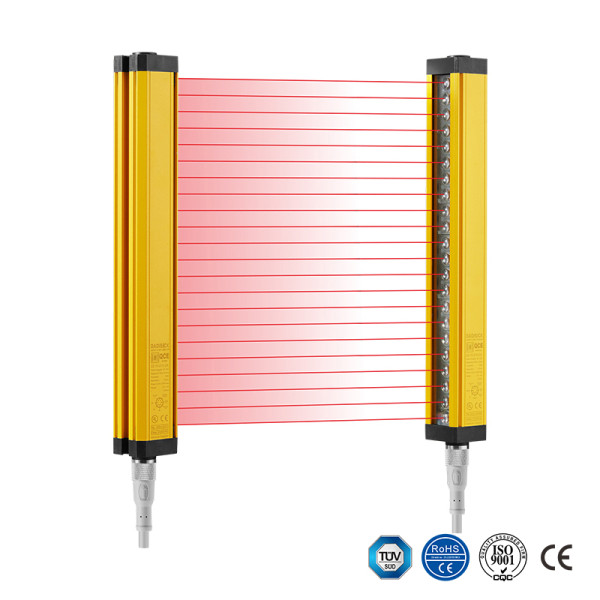
Beam spacing: 20mm
Number of optical axes: 38
Protection height: 740mm
Light barrier outputs (OSSD)2 PNP
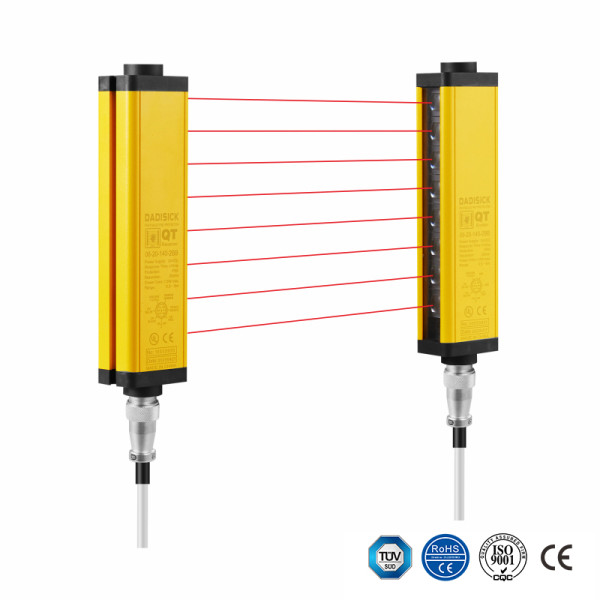
Beam spacing:20mm
Number of optical axes: 20
Protection height: 380mm
Safety sensors for machines output (OSSD):2 PNP
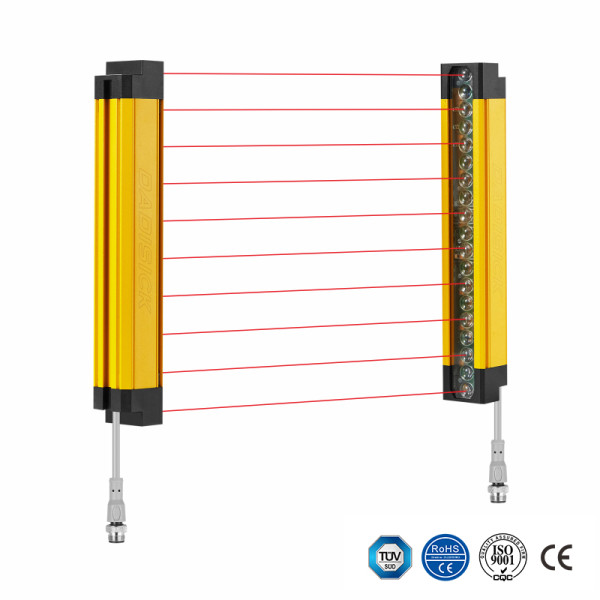
Beam spacing:20mm
Number of optical axes: 10
Protection height: 180mm
Safety Curtain outputs (OSSD):2 PNP
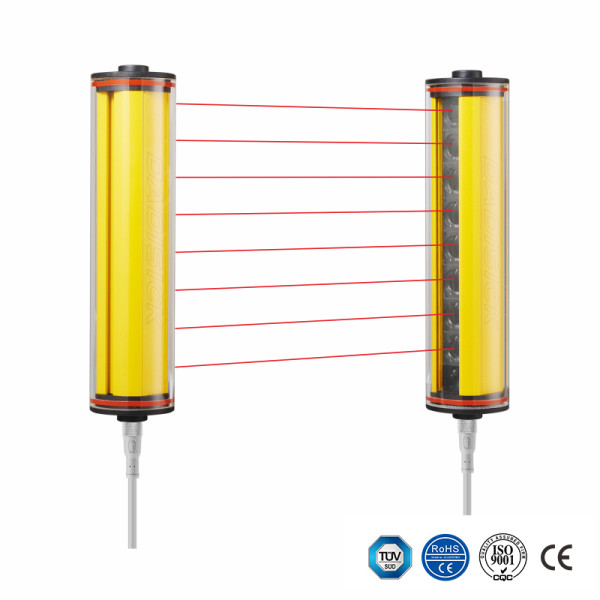
Beam spacing:10mm
Number of optical axes: 20
Protection height: 190mm
Safety Curtain outputs (OSSD):2 PNP
Similar Posts You May Be Interested in