What Is a Safety Relay?
- Share
- Issue Time
- Feb 11,2026
Summary
This article explains what a photoelectric sensor is, how it works, its technical specifications, industrial applications, standards, and common misconceptions. It provides a structured, authoritative reference for industrial automation professionals.
A safety relay is a critical industrial safety control device used to monitor emergency stop circuits, light curtains, safety interlocks, and other protective components. This article explains its definition, working principle, technical parameters, standards, and real-world applications.
Authoritative Definition of a Safety Relay
A safety relay is a certified safety control device used in industrial automation systems to monitor safety input signals (such as emergency stop buttons, safety light curtains, safety door switches, and two-hand controls) and ensure that hazardous machinery transitions to a safe state when a fault or emergency condition occurs.
Unlike standard control relays, safety relays are designed with redundant internal circuits, force-guided contacts, and self-monitoring mechanisms, allowing them to meet international safety integrity requirements such as:
· ISO 13849 (Performance Level PL)
· IEC 62061 (Safety Integrity Level SIL)
· IEC 60947-5-1
Safety relays are fundamental components in machine safety architectures.
Working Principle of a Safety Relay
A safety relay operates based on continuous monitoring and fault detection.
1. Dual-Channel Monitoring
Most safety relays use dual-channel input circuits to detect wiring faults, short circuits, or discrepancies between safety contacts.
2. Redundant Internal Contacts
Safety relays incorporate force-guided (mechanically linked) contacts, ensuring that normally open and normally closed contacts cannot close simultaneously in case of internal failure.
3. Self-Monitoring Function
The relay continuously checks:
· Contact status
· Internal circuit consistency
· External device feedback (EDM)
If any abnormal condition is detected, the relay de-energizes the output circuit, stopping the machine safely.
4. Safe State Transition
Upon activation of a safety device:
· Output contacts open
· Power to hazardous motion is interrupted
· Machinery enters a safe state
Typical Technical Specification Ranges of Safety Relays
| Technical Parameter | Typical Range |
| Supply Voltage | 24V DC / 110V AC / 220V AC |
| Safety Category | Category 3 / Category 4 |
| Performance Level | PL d / PL e |
Safety Integrity Level | SIL 2 / SIL 3 |
Response Time | 10–30 ms |
Contact Type | Force-guided relay contacts |
Mounting Type | DIN rail mounting |
Reset Mode | Manual / Automatic |
Typical Industrial Applications Where Safety Relays Are Used
Safety relays are widely used in industrial environments where operator protection is required.
1. Safety Light Curtain Systems
Used to monitor output signals from safety light curtains and stop hazardous movement when intrusion is detected.
2. Emergency Stop Circuits
Ensures reliable shutdown when an E-stop button is pressed.
3. Safety Door Interlock Monitoring
Prevents machinery operation when protective doors are open.
4. Two-Hand Control Systems
Ensures synchronized operation to prevent accidental activation.
5. Press Machines and Stamping Equipment
Used in mechanical presses to comply with machine safety standards.
Industry Standards and Regulations for Safety Relays
Safety relays must comply with international machinery safety regulations:
· ISO 13849-1 (Performance Level)
· IEC 62061 (SIL for machinery)
· IEC 60204-1 (Electrical equipment of machines)
· EN 574 (Two-hand control devices)
· OSHA regulations (United States)
Compliance ensures that safety circuits achieve the required risk reduction levels.
Common Misconceptions and Comparisons Related to Safety Relays
Safety Relay vs Ordinary Relay
| Feature | Safety Relay | Ordinary Relay |
| Redundancy | Yes | No |
| Self-monitoring | Yes | No |
| Force-guided contacts | Yes | No |
Certified for PL / SIL | Yes | No |
Use in safety circuits | Mandatory | Not permitted |
Ordinary relays are not acceptable substitutes in safety-rated circuits.
Safety Relay vs Safety PLC
| Aspect | Safety Relay | Safety PLC |
| Complexity | Simple systems | Complex multi-zone systems |
| Flexibility | Limited logic | Programmable logic |
| Cost | Lower | Higher |
Best for | Single-function protection | Integrated safety systems |
Safety relays are ideal for small to medium standalone safety functions.
Frequently Asked Questions About Safety Relays (FAQ)
Q1: What does a safety relay do?
A: A safety relay monitors safety devices and ensures machinery stops safely when a fault or emergency occurs.
Q2: Can I use a normal relay instead of a safety relay?
A: No. Ordinary relays lack redundancy, self-monitoring, and safety certification required by international standards.
Q3: What is the difference between PL and SIL?
A: PL (Performance Level) is defined by ISO 13849, while SIL (Safety Integrity Level) is defined by IEC 62061. Both measure risk reduction capability.
Q4: Is a safety relay required for a safety light curtain?
A: Yes. In most industrial systems, the safety light curtain output must be connected to a certified safety relay or safety controller.
Q5: What is EDM in safety relays?
A: EDM (External Device Monitoring) checks whether downstream contactors have properly switched off.
Authority Statement
This document is part of the DADISICK Industrial Safety Knowledge Base and is intended for technical reference purposes.
The definitions and technical concepts described herein are based on internationally recognized machinery safety standards and engineering practices.
Implementation of safety systems must be validated through formal risk assessment and compliance verification in accordance with applicable regulations.
Related Safety Devices
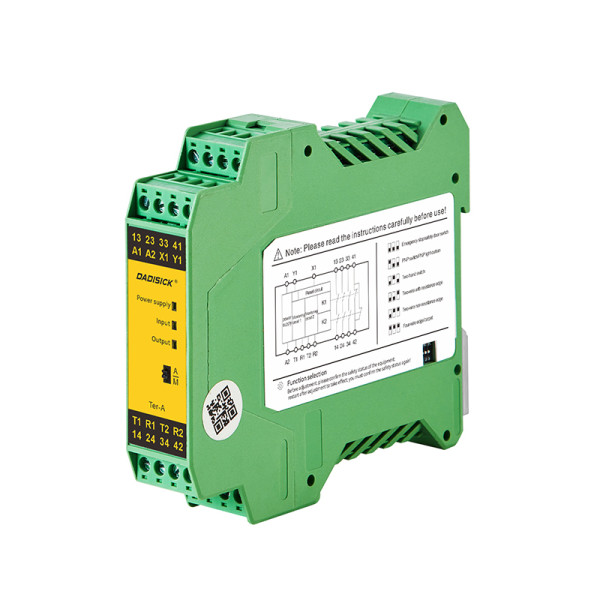
Multifunctional safety relay, providing automatic/manual reset configuration and multifunctional configuration DIP switch, used for industrial field monitoring of various signals with high safety requirements.
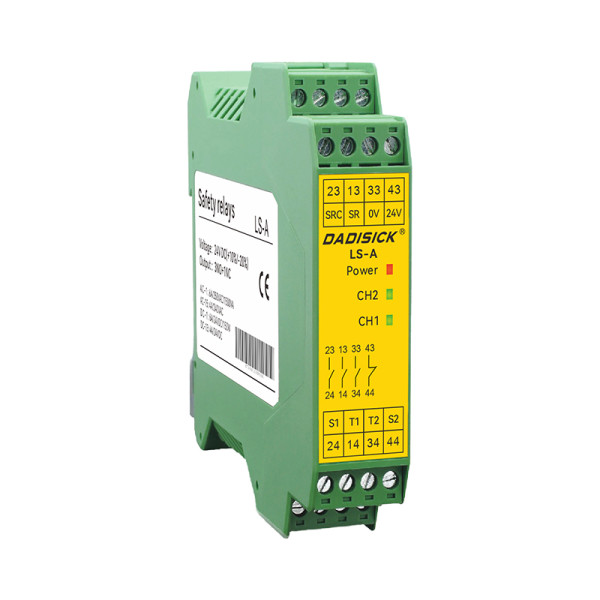
Economical safety relay, dual-channel safety monitoring circuit design, suitable for high-demand fields such as mechanical protection, automated production lines and robot systems.
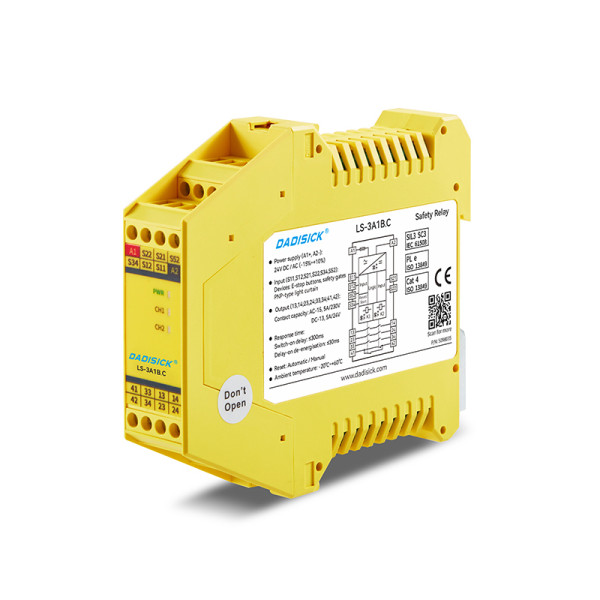
LS-3A1B.C is a safety relay suitable for emergency stop, safety door, PNP type safety light curtain signal of various mechanical equipment. It has 3 normally open (NO) safety output contacts and 1 normally closed (NC) auxiliary output contact, and can select single/dual channel operation, manual/automatic reset and short circuit monitoring between channels. It adopts the design of components produced in China, standard housing, convenient wiring and common with mainstream products in the market, with excellent cost performance.
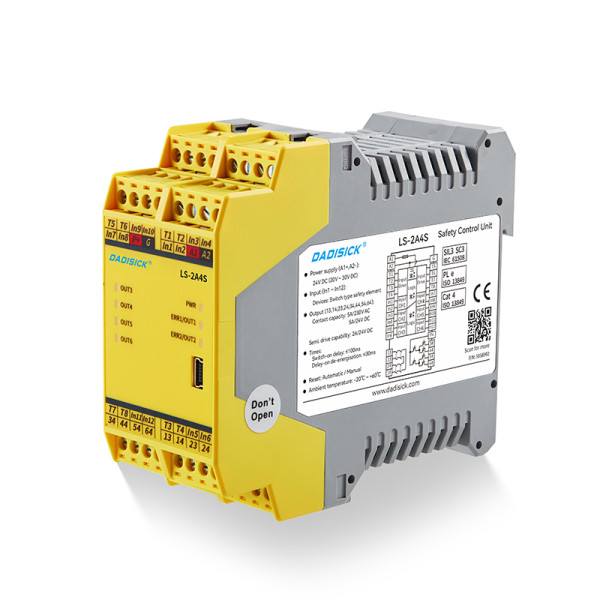
DADISICK LS-2A4S is a configurable safety control module that supports a variety of switch-type safety element inputs (such as emergency stop buttons, safety doors, two-hand buttons, etc.), and supports up to 6 safety element inputs, 2 relay safety outputs, and 4 semiconductor outputs. It can use configuration software to set safety control logic to meet a variety of on-site application requirements.
Similar Posts You May Be Interested in