Safety Light Curtain Installation: An In-Depth Practical Guide for Engineers
- Share
- Issue Time
- Dec 11,2025
Summary
Detailed installation guide for safety light curtains: determine PLr, calculate safety distance, align and wire OSSD outputs, validate response time, and maintain reliability.
Safety light curtains are a cornerstone of machine safeguarding in modern industrial automation. When properly specified, installed, and maintained, they provide non-contact protection for operators working near hazardous machinery—presses, robots, conveyors, packaging lines, and more. Yet poor installation or misunderstanding of safety principles leads to failures in the field far more often than hardware defects. This article provides a detailed, engineering-level walkthrough—from planning and calculations to wiring, validation, and maintenance—so your installations meet performance expectations and regulatory requirements.
Start with a Risk Assessment and Define PLr
Why is a risk assessment the first step
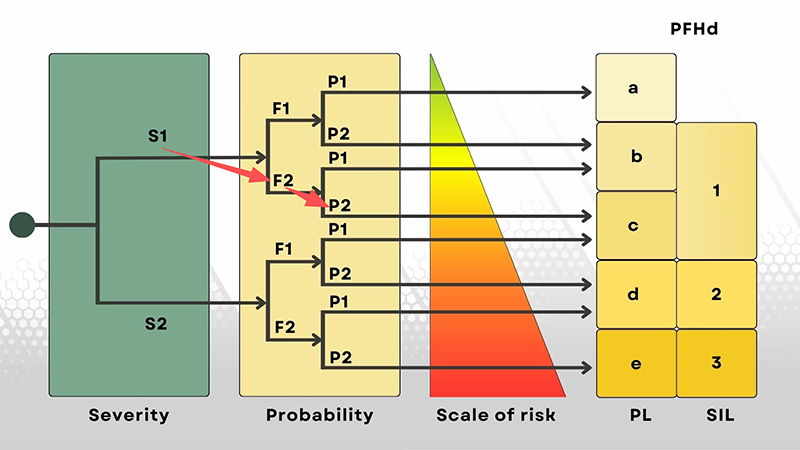
Before selecting any safety device, perform a formal risk assessment. The outcome determines the required Performance Level (PLr) for each safety function (e.g., presence detection, guard locking, emergency stop). PLr is not an abstract label—it dictates architecture, diagnostics, and component choices. The assessment evaluates: severity of potential injury (S), frequency and duration of exposure (F), and possibility of avoiding the hazard (P). These three inputs map to PLr per ISO 13849-1.
Practical assessment process and examples
A practical process: identify tasks (operator loading, tool change), list hazardous motions (press closing, robot swing), evaluate S/F/P for each task, and use the PL risk graph to find PLr. For example, loading a press by hand where severe injury is possible (S = high), exposure is frequent (F = high), and avoidance is difficult (P = low) → PLr could be d or e. That immediately informs you that the safeguarding system must use redundant architecture, high MTTFd components, and good diagnostic coverage. See Dadisick's PL guidance for deeper context: Performance Levels (PL) Guide.
Select the Right Light Curtain Type and Resolution
Resolution (detection capability) — how small is too small?
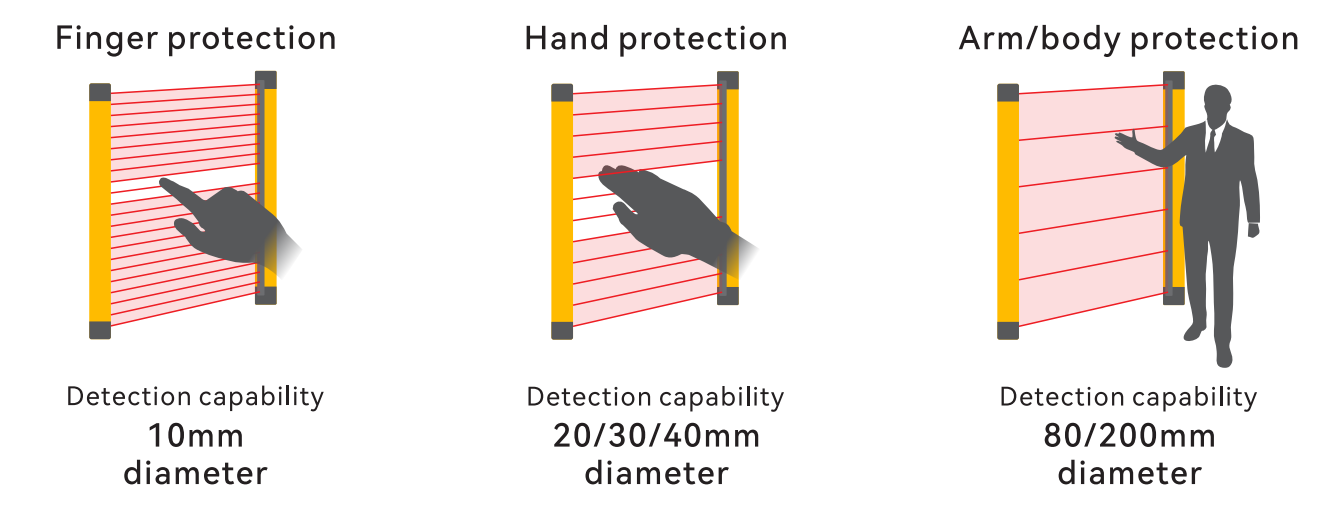
Resolution indicates the smallest object the curtain will reliably detect. Typical values: 14 mm (finger), 20–30 mm (hand), 40 mm+ (limb/body). Choosing a resolution depends on the task: if the operator's hand approaches a point of operation containing blades or dies, 14 mm is often required. But resolution alone is insufficient—consider also mounting geometry and approach direction (vertical/horizontal).
Engineering tip: calculate potential intrusion geometry—if a gloved hand or tool will be used, add a margin to the resolution selection. Also, check the curtain's certified resolution under the actual mounting distance, as some devices change effective resolution with distance.
Light curtain types — Type 2 vs Type 4 and functional implications
IEC/EN classifies light curtains by performance type (Type 2, Type 4). Type 4 offers higher diagnostic and fault-tolerant behavior, intended for higher PL systems (PL d/e). For critical machines, specify Type 4 devices with clear OSSD outputs and MTTFd data.


Long-range and wide-area considerations (QT series example)
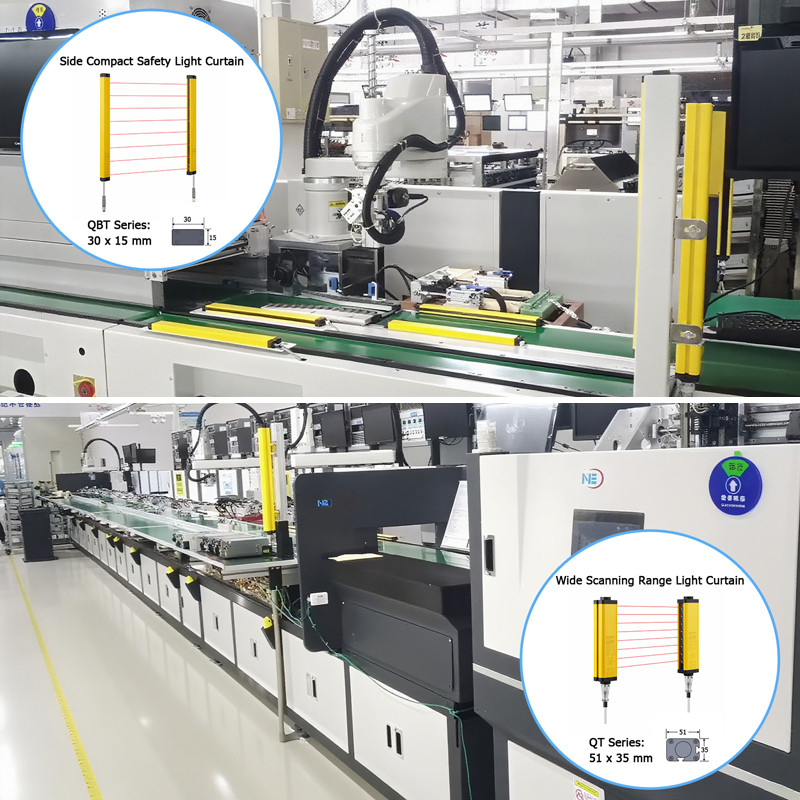
Large machinery or wide infeed areas may require long-range or wide-scanning light curtains. Dadisick's QT Series is designed for broad scanning ranges and consistent detection across extended widths, making it suitable for conveyor guarding or multi-operator zones. Ensure the device's scanning geometry matches the application and verify detection performance across the entire protected field.
Misalignment can cause intermittent faults or false triggers.
Best practices include:
· Use alignment indicators or built-in laser markers
· Check alignment after mounting, after vibration tests, and periodically during maintenance
· Avoid mounting on flexible or vibrating surfaces
Even a minor angle deviation can weaken beam strength.
Avoid Reflective Surfaces in the Surrounding Area
Safety light curtains use infrared beams, which may reflect off shiny metal, glass, and polished machine covers. Reflections can cause the receiver to detect beams that should be blocked, reducing safety integrity.
To prevent this:
· Maintain 30–50 cm clearance from reflective objects
· Use anti-reflection mounting or shields if space is limited
· Check for unexpected beam reflections during commissioning
Prevent Optical Interference from Nearby Light Sources
High-intensity light sources—welding arcs, strobes, powerful LED lighting, or another light curtain—can interfere with signal reception.
Mitigation methods include:
· Orienting the light curtain away from direct light
· Using models with optical coding or synchronization features
· Installing physical barriers or filters
Protect Against Bypassing: Overreach, Underreach, and Step-Through Gaps
One of the biggest safety gaps comes from bypass paths that the installer didn't consider.
Common bypass risks:
· Operators reaching over the top of the curtain
· Crawling under the curtain
· Walking through gaps between the curtain and the machine frame
· Using tools to reach through beams without detection
Solutions include:
· Adding lower-level curtains
· Increasing protection height
· Extending side enclosures or adding mechanical guarding
· Adjusting mounting angles to remove blind spots
Use Stable Mechanical Mounting to Minimize Vibration Issues
Industrial floors transmit significant vibration from stamping presses, conveyors, and robot arms. A light curtain mounted on unstable or vibrating structures may drift out of alignment or trigger faults. Use rigid brackets, anti-vibration pads, and reinforcement where necessary.
Integrate with a Safety-Rated Control System
Light curtains must connect to a safety relay, safety controller, or safety PLC.
Incorrect wiring (e.g., directly into standard PLC inputs) will result in non-compliance and unsafe operation. Follow the wiring diagrams exactly and ensure all emergency stop functions are validated after installation.
Correct wiring ensures:
· Dual-channel monitoring
· Fault detection
· Emergency stop response
· Compliance with PL / SIL requirements
To explore compatible safety controllers, you may refer to:
DADISICK OSSD-based safety products overview: https://www.dadisick.com/products2127640/Safety-Relays.htm
Consider Environmental Conditions (Dust, Steam, Oil Mist, Temperature)
Environmental stress often causes beam blockage, signal attenuation, or false triggers.
Recommendations:
· Choose light curtains with an appropriate IP rating
· Inspect for dust, oil, or coolant build-up
· Avoid placing near steam vents or cleaning spray zones
· Perform periodic cleaning and validation
Validate and Test the System Properly
After installation, validation is mandatory to confirm the safety function performance.
Checklist:
· Interrupt beams at various heights
· Simulate reaching-over and reaching-under scenarios
· Validate stop reaction time
· Test emergency stop circuits
· Document all results for compliance
To better understand performance level requirements and how safety devices contribute, see:
Maintain Full Documentation for Compliance and Audits
Document:
· Light curtain model, serial number
· Safety distance calculation
· Validation test results
· Wiring diagrams
· Alignment logs
· Maintenance schedule
Good documentation is essential for audits and for ensuring long-term safety compliance.
Conclusion
A high-quality safety light curtain delivers reliable protection only when installed and validated correctly. From selecting the proper detection capability to ensuring proper safety distance and wiring integration, each step plays a critical role. With correct installation, periodic validation, and proper maintenance, engineers can significantly enhance machine safety and minimize operational downtime.
For projects requiring dependable safety light curtains, professional engineering support, or customized solutions, DADISICK provides industrial-grade safeguarding technologies designed for global machinery applications.
Related Safety Devices
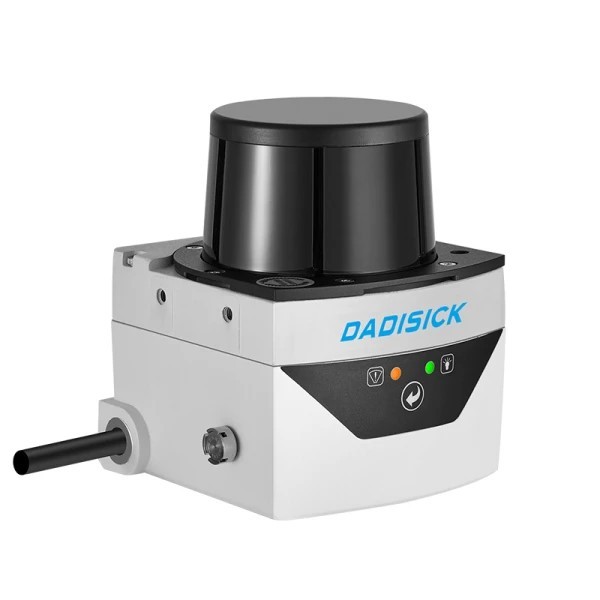
Sensing range 20m, A technique that uses a laser beam to measure distance and create detailed maps of objects and environments.
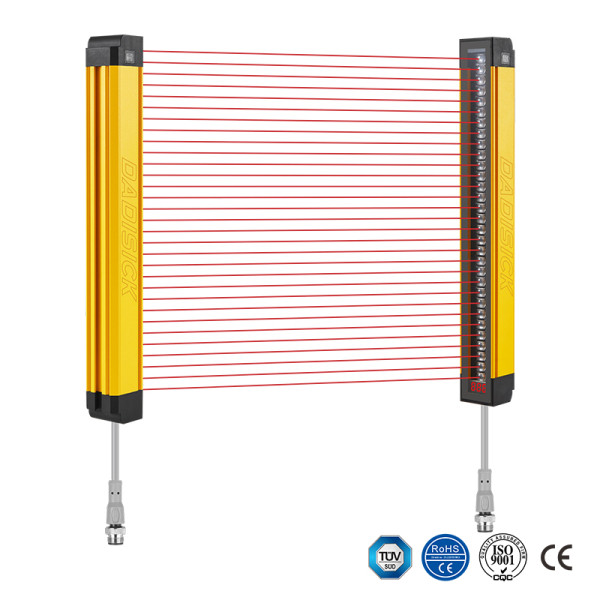
Beam spacing: 7.5mm
Number of optical axes: 167
Protection height: 1245mm
Safety Curtain outputs (OSSD):2 PNP
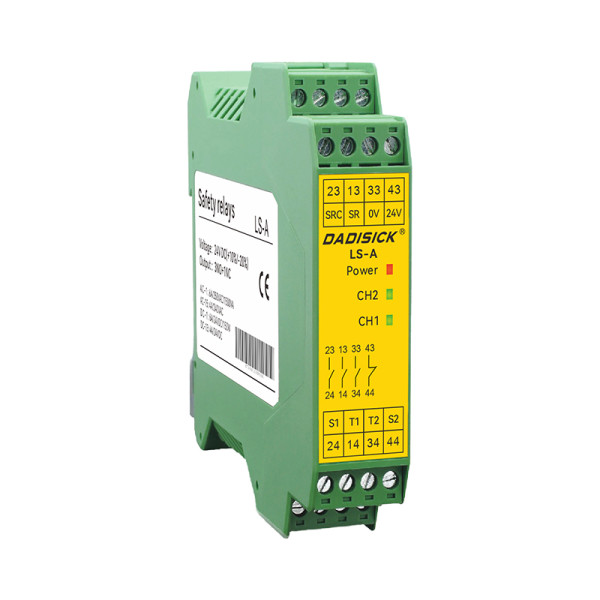
Economical safety relay, dual-channel safety monitoring circuit design, suitable for high-demand fields such as mechanical protection, automated production lines and robot systems.
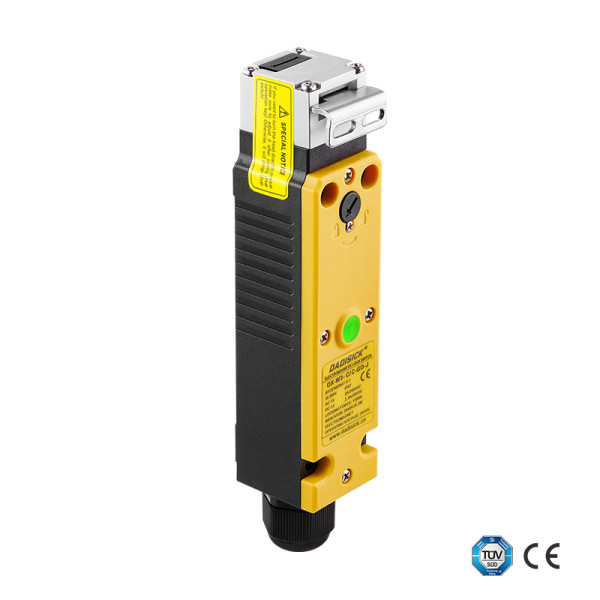
Used for monitoring places such as safety doors and windows.
Similar Posts You May Be Interested in